
Religious Freedom, Individual Mandate And Anti-Injunction Act At Issue In D.C. Circuit
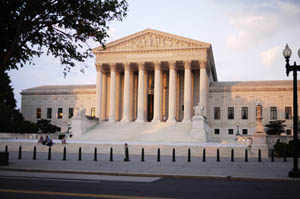
Supreme Court of the United States(Photo by Karl Eisenhower/KHN)
Health On The Hill: KHN鈥檚 Mary Agnes Carey and ABC News’ Ariane de Vogue discuss today’s oral arguments in the American Center for Law and Justice’s challenge to the health law.
.
MARY AGNES CAREY: Good day, this is Health on the Hill, and I鈥檓 Mary Agnes Carey. The Washington D.C. Circuit Court of Appeals heard arguments this morning concerning the health law鈥檚 individual mandate: A requirement that most individuals purchase health insurance before 2014 or face a fine. With us today to discuss the case is Ariane de Vogue who covers legal issues for ABC News. Thanks for joining us.
ARIANE DE VOGUE: Thank you.
MARY AGNES CAREY: This is the fourth appellate court to hear a challenge to the individual mandate. What can you tell us about the case?聽In what way were today鈥檚 arguments the same or different than those heard in previous court challenges?
ARIANE DE VOGUE:聽This case had drawn a lot of attention, because the panel聽hearing the case is composed of two very conservative …聽judges: Laurence Silberman,聽appointed by Ronald Reagan, and Brett Kavanaugh,聽appointed by George W. Bush. The third judge was Harry T. Edwards, and he was appointed by Jimmy Carter. But today, Silberman and Kavanaugh were very skeptical of the government鈥檚 principle argument, that is, that the mandate is constitutional because the Commerce Clause authorizes Congress to regulate economic activity.
As soon as the government鈥檚 lawyer stood up to make her argument, they pounced and they asked, in essence: “What are the limits on the federal government?” Judge Kavanaugh worried about an expansion of the [social safety]聽net. And Judge Silberman,聽asked “Well, could the government mandate you to buy a car?” And that brings in the Obama administration lawyer, she said that it鈥檚 not about forcing someone to buy a product, it鈥檚 about the financing of the product that every individual will need sometime in their life.
MARY AGNES CAREY: In this case, the plaintiffs are also arguing Congress doesn鈥檛 have the power to require consumers to purchase health insurance. They鈥檙e arguing that, but they鈥檙e also challenging the law on religious grounds. Can you tell us a little bit about how much of that, of a role did that play today?
ARIANE DE VOGUE: Well, unlike some of the other cases that have been brought by the states, this challenge is brought by four individuals represented by the conservative American Center for Law and Justice. And in court today, their lawyers argued that they believe that the mandate violates their religious freedom. The plaintiffs wanted to be able to have the choice for God to take care of them. They don鈥檛 want to be forced by a mandate or pay a penalty, they think God will take care of them, and as their lawyers said, they feel like this mandate forces them into a market.
Now they also argue as most of the other challengers have, that in fact, while Congress might have the power to regulate interstate economic activity, it doesn鈥檛 have the power to regulate inactivity or their choice not to participate.
MARY AGNES CAREY: But there are exemptions for religious concerns, right, in the health law? So why wouldn鈥檛 these folks qualify for a religious exemption?
ARIANE DE VOGUE:聽 It鈥檚 interesting.聽 Those exemptions are extremely narrow.聽 And I was talking to their lawyers about it, and they said that those exemptions only apply to the Amish.聽 What鈥檚 interesting is 鈥� as you know 鈥� this case was dismissed at the lower-court level, and the judge said she was striking it down in part because these challengers 鈥� if they didn鈥檛 want to purchase the mandate, they could simply just pay the penalty.
MARY AGNES CAREY:聽 So you mentioned earlier about we鈥檝e got a three-judge panel; we鈥檝e got two Republicans and a Democrat.聽 And you talked a lot about their questions on the Commerce Clause.聽 What other sorts of areas did they explore, and how do you think those might change shape the eventual ruling?
ARIANE DE VOGUE:聽 It鈥檚 hard to tell.聽The other appeals courts, they鈥檝e taken about three or four months to rule on the issue.聽 And it鈥檚 difficult to read the tea leaves about how this will come out or when it will come out.聽 But there was one interesting thing that occurred.聽 And it鈥檚 kind of technical, but it鈥檚 very important.聽
One of the other appeals courts that recently heard arguments on this came out and dismissed the challenge and said that the challenge could not go forward now, because there鈥檙e a federal law 鈥� the Anti-Injunction Act 鈥� that actually bars lawsuits before a tax penalty is actually assessed.聽
So, you know this is about the individual mandate and the penalty, but it doesn鈥檛 take effect until 2014.聽 So today in court, Judge Kavanaugh seemed to agree with this position.聽 And that鈥檚 important as an issue of timing.聽 Because if he believes that this law bars any challenge, the timing of when the challenges could occur shifts to 2015, and that鈥檚 a long time down the road.聽
MARY AGNES CAREY:聽 So, you鈥檙e saying that maybe the individual mandate issue here in the health law may not be decided until well beyond 2014.
ARIANE DE VOGUE:聽 Well, if this argument takes off, and if another appeals courts agrees with the Virginia appeals court [4th Circuit Court of Appeals] that found it, this means that the challenges can鈥檛 be brought, because the penalty hasn鈥檛 been assessed, because it only takes effect in 2014.聽
MARY AGNES CAREY:聽 Looking ahead, what other legal challenges to the health law should be we watching?
ARIANE DE VOGUE:聽 The thing really to watch now is the Supreme Court and whether and when the court is going to step in.聽 We鈥檝e talked about what happened with the Anti-Injunction Act.聽 But most people believe that the Supreme Court, because the circuits have split on the constitutionality of this mandate, and because it鈥檚 a major piece of legislation, it鈥檚 going to step in.聽 It鈥檚 going to take up the issue at some time.聽 The question is when.聽
They have some challenges in front of them now, so the justices could agree to step in.聽 If they do so before the first couple of weeks of January –聽if they agree to take up one of the cases or a consolidated version of one of the cases –聽then it will be heard this spring, and it will be decided by early summer.聽 And that essential, of course, because that comes in the heat of the next presidential campaign.聽 So people wonder, how quickly would the Supreme Court move?聽 Maybe they鈥檇 wait to see the result of today鈥檚 case before stepping in.聽 And that would push it not to the term that鈥檚 about to start, but maybe the term after that.
MARY AGNES CAREY:聽 So it鈥檚 shaping up to be an exciting 2012 and beyond for the health law.
ARIANE DE VOGUE:聽 It really is.聽 The court challenges have all been different, they鈥檝e all had their own characteristics, and it鈥檚 been fascinating to watch.
MARY AGNES CAREY:聽 Well thank you so much, Ariane de Vogue of ABC News.


