
Former HHS Head Offers His Take On Health Law’s Problems

Former HHS Head Offers His Take On Health Law's Problems
Michael O. Leavitt, during the George W. Bush administration, oversaw another troubled rollout 鈥� that of the Medicare prescription drug benefit in 2006, which also was criticized for computer glitches, long waits for telephone assistance and consumers incorrectly enrolled in coverage. Leavitt, a former Utah governor who opposed the Affordable Care Act, now runs , a consulting firm that works with health care organizations and state governments on implementing the law.聽Julie Appleby of Kaiser Health News spoke with him recently about the rollout of healthcare.gov. What follows is an edited transcript of their conversation:
>> .
KHN: What are the biggest challenges facing the administration as the law rolls out?
Leavitt: They have to make the system logistically work properly.聽 That鈥檚 No. 1. No. 2, they鈥檙e going to have to deal with the change required.聽 For some it will be a different premium, up or down. For others, it will be a new panel of doctors they are not accustomed to, or a new insurance plan. There will be a lot of change that will, in fact, be thrust upon the American people.聽 It鈥檚 fair to add there will be a lot of political dynamics that play out as a result.
KHN:聽 What workarounds do insurers need if things have gone wrong on the back end?
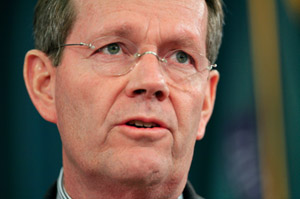
Former Health and Human Service Secretary Michael Leavitt (Photo by Chip Somodevilla/Getty Images).
Leavitt: The administration needs to come up with the 60 percent workaround. That is, they鈥檝e got to find a simple way to solve a complex problem, which will have imperfections for everyone. We did the [Medicare] prescription drug plan in 2006 and had lesser problems, but of a similar nature, where people were walking up to the pharmacy counter to get their drugs and their name wasn鈥檛 in the computer. Ultimately, we had to say, 鈥榞ive them their drugs, and we鈥檒l work it out later.鈥� Then we spent 15 or 18 months working it out later. It was an expensive proposition and less than ideal.聽 But it allowed the limited number of people who were having problems with the system to have their human needs met. [Now] they have bigger problems, they have more people, more complexity, so their workaround may not be the exactly same, but that illustrates it.
KHN: They鈥檝e asked insurers to let consumers pay their first premium bills later, get prescription drugs that are not in the formulary for a while longer and let patients stay with their providers for a while, even if they are not in the new networks. Can insurers do that?
Leavitt: There鈥檚 a lot of question about whether they can or should be expected to do it. One strategy that appears to be playing out here is the administration appears to be saying we鈥檒l sacrifice in the short run the actuarial soundness of this program, relying on the balance sheets of insurance companies with assurances that we will make it up to them later. But there鈥檚 not a lot of trust between the administration and insurance companies. Simply giving them assurances they will work it out later in a way that is fair is not likely to carry the day.聽 Ultimately, they will have to make some financial guarantees, in my assessment.
KHN: What would that look like?
Leavitt: You need to give them a sense of legal enforceability, as opposed a simply a handshake and a 鈥榳e鈥檒l take care of you, pal.鈥� Right now they鈥檙e not feeling like pals. They鈥檙e feeling endangered.
KHN: Are insurers angry?
Leavitt: I would say they are frustrated. It鈥檚 not without merit.聽 My guess is the administration is [also] feeling frustrated. They didn鈥檛 plan on this. It鈥檚 just going to require a lot of patience for people to work through.聽 Unfortunately, that鈥檚 not something the public has a lot of.
KHN: What is your take on enrollment so far?
Leavitt: It鈥檚 unlikely they will hit their targets.聽 It seemed unlikely to me they would hit targets at the beginning. But we鈥檙e seeing more disruption than anticipated occurring.聽 [If they don鈥檛 get the enrollment] needed to make it actuarially sound, we鈥檙e likely to see higher premiums.聽 The objective for the administration at a moment like this is to keep it going at whatever cost.聽 At some point in time, it will smooth it out. It鈥檚 a logical strategy; it鈥檚 what they have to do.
KHN: You spoke at a conference recently and said it鈥檚 important for insurers to have the ability to create small or narrow networks in order to keep health reform moving forward. Can you explain that?
Leavitt: When I spoke of health reform, I was not just speaking of the Affordable Care Act, I was thinking of reform in general, where we are seeing a smaller percentage of the economy going to health care.聽 For that to occur under any construct, consumers have to have the ability to make decisions for their own best interest. For some [consumers, they鈥檇] like to have a lower premium and are prepared to get that to have fewer choices and be willing to take on a little more risk. That鈥檚 not good for everyone. But it is good for many people.聽 Without that choice, people will become discontented. Unless [insurers] have the ability to narrow networks over time, you can鈥檛 constrain costs. If you require everyone to have everything, then costs will continue to go up. I鈥檓 not suggesting everyone should have a narrow network, but [people] ought to have choice based on their own priorities. Over time, government will get it wrong for most people, but people will get it right for most people if they鈥檙e allowed to choose. That鈥檚 what will ultimately drive reform.
KHN: What are main pitfalls you see facing the legislation over the next couple of years?
Leavitt: The main pitfall for the Affordable Care Act is just execution.聽 That鈥檚 No. 1. And No. 2, there are some fundamental flaws in reasoning. You can鈥檛 give tens of millions of people more care without paying for it somewhere.聽 The way in which they have chosen to pay for it, there鈥檚 a whole series of actions that are not likely to happen. We haven鈥檛 begun to see that play out yet.聽 The pricetag for the Affordable Care Act was primarily paid for by a series of Medicare cuts that have not yet begun to mature. When they do, there will be another round of disruption and discontent and another round of political anxiety. 鈥� It鈥檚 not something that means it will fail, it just means it will be far more interesting to watch.聽
KHN: Can you name other actions that might not happen or are questionable in terms of raising money?
Leavitt: That鈥檚 the main one I would point to. It鈥檚 over half. [The] cost of this was roughly a trillion dollars. The Medicare reductions amounted to about $500 billion. That鈥檚 a big category and encompasses many, many, many different actions. So lumping it into one category isn鈥檛 a very good picture. There are thousands of different things that will occur, and each will make a certain number of people unhappy.
KHN: What mistakes were made by the administration in rolling this out?
Leavitt: The first one was that they did not choose a single person [or firm] to be responsible for the full implementation.聽 They didn鈥檛 have a systems coordinator. They created lots of different contracts and concluded they could coordinate it themselves.聽 So individual contractors thought they were all doing a wonderful job. But it was like building an airplane and not having a general contractor. The second would be they failed to issue regulations that were necessary for their partners鈥攂y that I mean insurers and others 鈥� to respond quickly enough. There鈥檚 good evidence they chose not to issue those regulations during the political season of 2012. They didn鈥檛 want the controversy during the election.聽 It threw the whole process behind.
KHN: The administration made an announcement [recently] that people whose plans were canceled could qualify for a hardship exemption and purchase a catastrophic plan if they want. What do you make of that?
Leavitt: They鈥檙e trying to find ways to keep enough momentum moving forward.聽 Think about it like a big snowstorm, and you鈥檙e trying to drive a car uphill. The most important thing is to keep momentum and keep it out of the ditch. You might swerve from side to side, or might even do a circle or two. But if you can keep the momentum going up the hill, then you can ultimately succeed. They鈥檙e driving on a slick road up a stormy hill. They will do some things they hadn鈥檛 anticipated. But forward momentum is their game. At the end of the day, we鈥檒l find out. They may get there; they may end up in a ditch. They may have a collision. Who knows?聽


