
This article was produced in partnership with , a nonprofit newsroom covering gun violence in America. .
JACKSONVILLE, Fla. 鈥� In a Florida county with a startling rate of child firearm injuries, a boarded-up elementary school named for famed educator and civil rights activist Mary McLeod Bethune sits in a 250-acre site once called 鈥�.鈥�
The dump emerged in an era of redlining, systematic racism that divided American cities large and small. From the late 1940s until the mid-1950s, the city operated a landfill here, heaping toxic ash from nearby municipal incinerators.
The Duval County School Board in the 1950s built a school there. On the surrounding land, developers built homes and apartment complexes.
Generations of Black children lived, learned, and played on the polluted land. It was first assessed as a potential Superfund site . In 1999, the federal government and state of Florida at Brown鈥檚 Dump 鈥減osed a potential public health hazard.鈥�
The school closed in 2001. And eight years later, officials finally of cleaning up lead, arsenic, and other contaminants.
But the poisons had seeped into the lifeblood of residents. The harm to their physical and mental health is tied today to another public health crisis: high rates of gun violence.
A study led by researchers at the University of Wisconsin-Milwaukee found that lead exposure in the first six years of life was with an increased risk of firearm violence in early adulthood. And across the nation, people living in neighborhoods that were long ago segregated face a from gun violence today than residents in other neighborhoods, .
鈥淚t鈥檚 the legacy of segregation and redlining,鈥� said Lindsay Emer, lead author of the Wisconsin study. 鈥淚t鈥檚 a huge environmental injustice to our African American population.鈥�
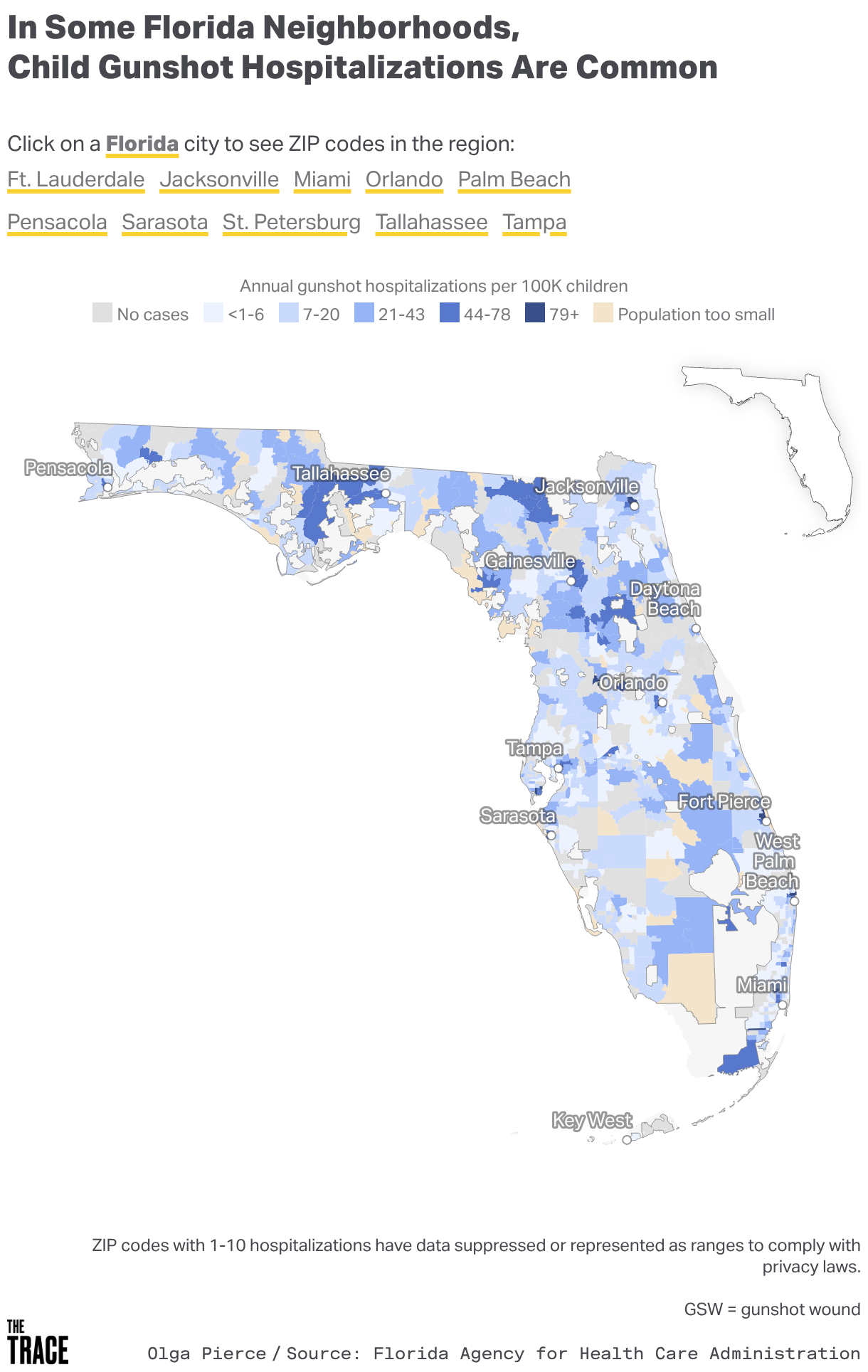
That legacy has shaped a tragic disparity in Jacksonville, which has three of the 10 worst ZIP codes for child firearm injury rates in Florida, according to an analysis of hospital claims data obtained by 吃瓜不打烊 and The Trace.
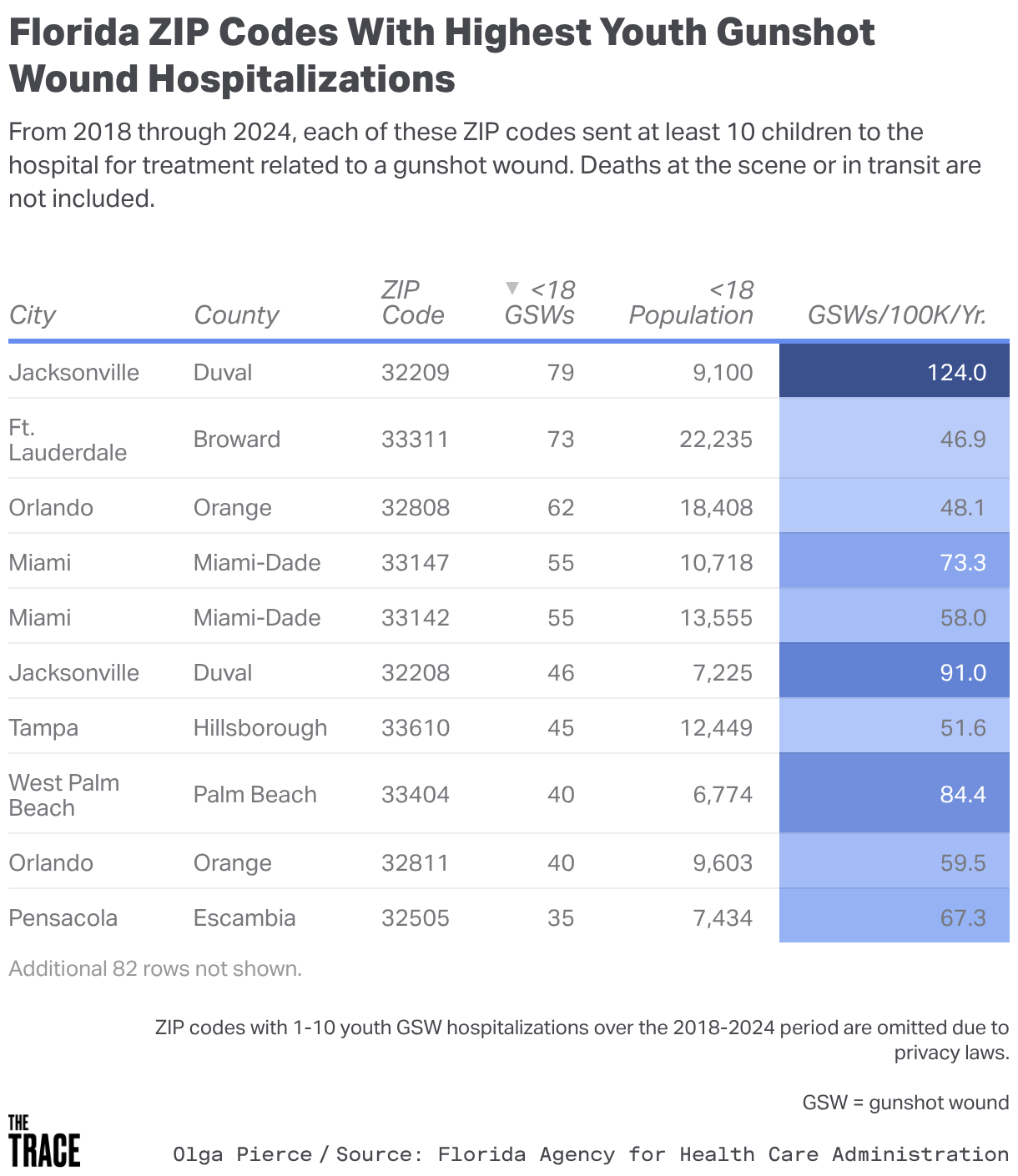
Hospital billing data obtained from the Florida Agency for Health Care Administration shows that from 2018 to 2024 more than 4,000 children in the state were hospitalized for firearm injuries 鈥� about 1.5 a day.
The data was obtained exclusively for this reporting on firearm injury hospitalizations in the state. The newsrooms spent more than a year analyzing the records, which did not identify patients. The data contained patients鈥� residential ZIP code, age, race, and other demographic information.
At least 375 children under age 18 in Jacksonville have been hospitalized for firearm injuries since 2018 and at least 150 from ZIP codes 32206, 32208, and 32209 鈥� where Brown's Dump is located.
鈥淲e have to work hard to make sure our kids get home safe,鈥� said A.J. Jordan, a community organizer who has worked with families of gunshot victims. 鈥淎nytime we let them out in this society, they could be killed.鈥�
Jacksonville has a of Black culture and community that stretches from the early days of Reconstruction through the Civil Rights Movement to present-day environmental justice activism. But the city, rooted in the Deep South, falls under the long shadow of its legacy of racism.
In the 1930s, the federal government deemed and undesirable for mortgage lending because Black people lived there. Officials color-coded maps, marking mostly white areas green and predominantly Black districts red, a signal to lenders to avoid investing in those neighborhoods.
Around the country, local authorities then disproportionately permitted , , and other industries linked to to be built in or near communities of color.
Redlining was , but the U.S. Justice Department alleged that it was practiced in Jacksonville鈥檚 minority neighborhoods in recent years.
In 2023, it with Ameris Bank, which it accused of redlining predominantly Black and Hispanic portions of the city.
In a at the time, Ameris CEO Palmer Proctor said, 鈥淲e strongly disagree with any suggestion that we have engaged in discriminatory conduct.鈥� The bank a loan subsidy fund, enhance outreach and community partnerships, and open its first branch in a minority neighborhood. It reported nearly $26 billion in assets under management at the time of the settlement.
To this day, redlining .
Black neighborhoods north and northwest of downtown Jacksonville endure poverty, , and , cancer, and other diseases 鈥� and hundreds of shootings involving children.
Jeffrey Goldhagen, a professor emeritus of pediatrics at University of Florida Health Jacksonville and a former county health director, has studied the link between lead exposure and high firearm injury rates.
鈥淚f somebody came to me,鈥� he said, 鈥渁nd said, 鈥榃hat鈥檚 among the most important things you can do to impact gun violence on the Black community,鈥� I鈥檇 say, 鈥楪et the lead out of the environment.鈥欌��
Public health experts, grieving parents, and activists say the violence has created a collective trauma in neighborhoods where people brace for the next shooting death.
So many Jacksonville children are lost to gun violence that a 鈥淲all of Compassion鈥� memorializes them. When organizers ran out of room, they stood up a second wall in a nearby parking lot.

Not far from the memorial, Jacksonville has opened a new medical examiner鈥檚 office and morgue across the street from a school, a move denounced by neighbors.
Anthony Brown, founder of the Red Alliance for Justice, a community group, said protests over the morgue, the history of redlining, and ongoing gun violence are interconnected. Brown said the City Council spent more than $60 million to build the morgue but has not created a dedicated funding source to make life better in redlined neighborhoods.
鈥淲e need something that has teeth,鈥� Brown said. 鈥淲e want some tangible action.鈥�
The Morgue
In 2024, the Jacksonville City Council unanimously approved a resolution to 鈥渞edress the effects of redlining still felt today.鈥�
Two years later, there is little evidence of progress, according to public health experts, doctors, and grieving parents and community activists.
Wells Todd, a community activist, noted the city is named for Andrew Jackson, the seventh U.S. president and a wealthy slaveholder who is honored in the city鈥檚 downtown waterfront with a larger-than-life .
鈥淪ometimes living here is like being in a time capsule,鈥� Todd said. 鈥淭his is about white supremacy.鈥�
On a sidewalk in front of City Hall last fall, a small group marched during the lunch hour to protest the construction of the medical examiner鈥檚 office and morgue in Brentwood, a predominantly Black neighborhood north of downtown.
Protesters carried signs that read 鈥淛ax still has racism in: Housing, education, policing, healthcare and city hall.鈥� Some wore T-shirts with the words 鈥淒ream,鈥� 鈥淩esist,鈥� and 鈥淔lourish.鈥�


Residents had pleaded for an urgent care center or a pharmacy on the site. Instead, in 2024, city officials allowed the project to move forward. Today the morgue serves five counties.
For some locals, the decision was a slap in the face.
It鈥檚 across the street from a public charter school, which neighbors say makes it a symbol of both the city鈥檚 abysmal firearm injury rate for kids and systemic racism.
Lydia Bell, a lifelong resident, said the morgue felt like a second wave of redlining.
鈥淭hey have so much disrespect for Black people,鈥� she said.


Jacksonville once fought to keep Black people from moving into .
Bell said she believes the city placed the morgue in the neighborhood because of its residents now are Black. She said its presence could send a negative message to children about the worth of the lives in the neighborhood.
鈥淚 saw this as a child,鈥� Bell said, 鈥渁nd now I am fighting it when I鈥檓 supposed to be enjoying being a grandmother.鈥�
()
A spokesperson for Jacksonville Mayor Donna Deegan declined to answer questions about gun violence and racial inequality.
Of 19 members of the Jacksonville City Council, only Council members and responded to requests for comment.
The city鈥檚 north side 鈥渉as really kind of been ravaged over the years,鈥� Peluso said, 鈥渁nd I feel like it's not given the proper opportunity to kind of stand on both feet.鈥�

The Cleanup
Spencer Fletcher, who has worked to in a historically Black Jacksonville neighborhood, said the stories he hears at community meetings are disturbing.
Children played on playgrounds where workers dumped toxic incinerator ash, Fletcher said. People were told it was good for potting soil, so some used it in their gardens, he said.
That part of the city鈥檚 history 鈥� and its health effects 鈥� are often downplayed, Fletcher said.
鈥淚t鈥檚 like it never happened,鈥� he said.
Incinerator ash and contain high concentrations of lead, mercury, arsenic, and cadmium. Rain can cause contaminants to leach into groundwater, and to cancer, kidney damage, and developmental problems in children. The in house paint in 1978.
A December 2024 Environmental Protection Agency report said much of the Brown鈥檚 Dump site had been cleaned or covered with enough new soil to reduce exposure to people and protect groundwater in the area.
The EPA also reported that year that authorities were cleaning a second Superfund site on the city鈥檚 north side called the . The three parcels covering more than 1,100 acres include a 250-acre park, with residential and commercial areas occupying the former sites of municipal incinerators.
EPA officials wrote that the contamination no longer threatens people living or working near them.
But Goldhagen, the professor emeritus at UF Health Jacksonville, said severe damage had already been done.
Jacksonville has one of the highest lead poisoning rates in Florida. There is no known safe for humans, and even small amounts can impair cognitive development, attention, and behavior in kids. Black children, other people of color, and those living in low-income households are at the , studies show.
Goldhagen and other public health leaders say lead exposure early in life can affect brain development and impulse control as children grow older. He noted the Wisconsin study by Emer and her colleagues.
Emer鈥檚 research team studied more than 89,000 people in Milwaukee who were tested for lead exposure by age 6. Even after controlling for other factors such as race, sex, and neighborhood socioeconomics, they found that lead exposure increased the risk of becoming a perpetrator or victim of firearm violence.
The results show 鈥渢he potential importance of lead exposure reduction in firearm violence prevention efforts,鈥� the researchers said.
Sara Baldwin is a forensic social worker who researches a defendant鈥檚 medical and social background to present mitigating factors that can reduce sentencing in criminal cases in Florida and other states.
鈥淚 always say the school-to-prison pipeline is lined with lead,鈥� Baldwin said.

Teri Sopp, an assistant public defender for the state鈥檚 Fourth Judicial Circuit, which includes Jacksonville, said it鈥檚 unsurprising that so many children suffer gunshot injuries. People grew up swimming in lead-contaminated creeks, she said.
Local officials have long been aware of anecdotal evidence that lead poisoning caused violence, but failed to seek remedies, Sopp said.
鈥淭here needs to be a large-scale assessment of the situation,鈥� she said.
Once the federal government, the state, and the city began efforts to clean the sites, the county health department under Goldhagen began to examine the effect of lead exposure and other environmental hazards in these communities.
鈥淲e tested hundreds and hundreds of kids from the community,鈥� he said. 鈥淲e really couldn鈥檛 find it, because the ash was buried under dirt that had accumulated over the years. But yes, I think it did have an impact.鈥� He added that 鈥渢he impact of lead-based paint in homes was greater than the lead in the ash.鈥�
Goldhagen said testing was an effort to address one of the 鈥渞oot causes鈥� of gun violence. But he said that in the last 20 years, local and state leaders have largely abandoned a public health approach to gun violence.
鈥淭his is a disease,鈥� he said, 鈥渁nd we need to use rigorous public health approaches to address it.鈥�
Goldhagen, who led Duval County鈥檚 health department from 1993 to 2005, said Florida鈥檚 statewide system of county health departments has been hollowed out by years of staff and budget cuts, diminishing their ability to address public health crises.
A 吃瓜不打烊-Associated Press analysis of state data found that the health department in Duval County had the equivalent of 852 full-time employees and spent about $91 a person in 2008 but by 2019 had only 422 workers and spent $34 a person.
鈥淭here was a commitment to public health in the state,鈥� Goldhagen said, 鈥渂ut that commitment has been slowly and under [Republican Florida Gov. Ron] DeSantis rapidly dismantled so the public health departments in each of the counties are a shadow of what they were.鈥�
The , a set of goals developed by the state health department and an advisory committee, does not mention guns, the toll they take on children, or efforts to reduce firearm deaths and injuries to young people.
鈥淭his is a story the government doesn鈥檛 want told,鈥� said Baldwin, the mitigation specialist. 鈥淲e would get these cases and everyone in this person鈥檚 family has been incarcerated. Why did this whole family go to prison? Well, let鈥檚 look at where they lived.鈥�
Jacksonville Councilwoman Pittman, whose district includes the Brown鈥檚 Dump site, said the city, state, and federal governments have made progress cleaning up contaminated areas. But more needs to be done, she said.
鈥淩emediation of contaminated soil does not, by itself, repair generations of neighborhood disinvestment,鈥� she said, adding that a long-term solution will require sustained spending on housing, public health, education, and economic development.

Pittman said the legacy of Brown鈥檚 Dump is 鈥渆specially troubling鈥� because of the burdens it placed on those who lived nearby.
鈥淭he history matters,鈥� she said, 鈥渂ut our responsibility today is to determine what we are going to do about the conditions that continue to affect our youth and families.鈥�
Documents from the 1930s showed a federal government appraiser discouraged investment in some areas north of downtown Jacksonville, saying the residents were Black people and the neighborhoods lacked sufficient sewer and water infrastructure, sidewalks, and roads in good condition.
鈥淚t listed all these things back in 1934 as reasons not to invest, to provide private capital into these neighborhoods,鈥� said Peluso, who co-sponsored the City Council鈥檚 redlining resolution. 鈥淎nd if you look today, a lot of those areas that were redlined 鈥� you could say the exact same thing.鈥�
吃瓜不打烊 data editor Holly K. Hacker contributed to this report.
This report was produced by 吃瓜不打烊, The Trace, and Action News Jax.
吃瓜不打烊 is a national newsroom that produces in-depth journalism about health issues and is one of the core operating programs at KFF鈥攁n independent source of health policy research, polling, and journalism. Learn more about .